
Belmont Community Primary School
Is My Child Well Enough For School?
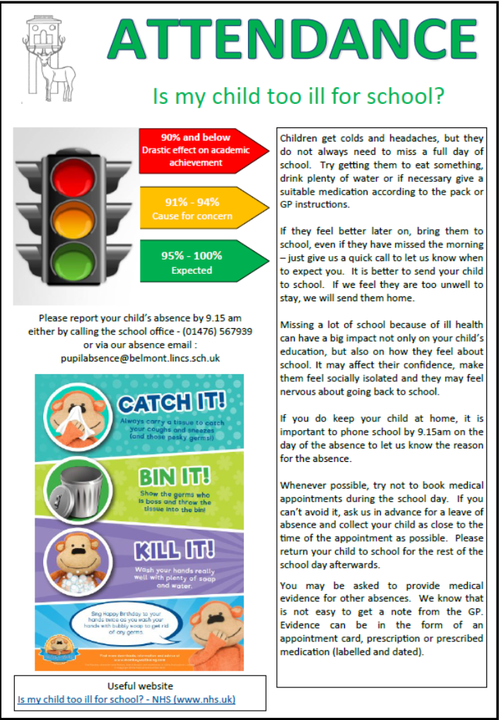
You may have concerns over whether your child is well enough to attend school. Children get colds and headaches, but they do not always need to miss a full day of school. Try getting them to eat something, drink plenty of water or, if necessary, give a suitable medication according to the pack or GP instructions.
If they feel better later on, bring them to school, even if they have missed the morning – just give us a quick call to let us know when to expect you. It is better to send your child to school. If we feel they are too unwell to stay, we will send them home.
Missing a lot of school because of ill health can have a big impact not only on your child’s education, but also on how they feel about school. It may affect their confidence, make them feel socially isolated, and they may feel nervous about going back to school.
If you do keep your child at home, it is important to phone school by 9:15 am on the day of the absence to let us know the reason for the absence. Whenever possible, try not to book medical appointments during the school day. If you can’t avoid it, ask us in advance for a leave of absence and collect your child as close to the time of the appointment as possible. Please return your child to school for the rest of the school day afterwards.
You may be asked to provide medical evidence for other absences. We know that it is not easy to get a note from the GP. Evidence can be in the form of an appointment card, prescription or prescribed medication (labelled and dated).
If your child has been absent from school with an upset stomach leading to vomiting or diarrhoea, then they must not return to school for 48 hours after the last bout of illness.
For Advice On Childhood Illnesses
Please click on the guides and web links listed below.
Illness & Medicines In School
ILLNESS IN SCHOOL
If your child is taken ill in school or has an accident, you will be contacted. For this reason, it is vital that if you change your address or telephone number, or work details, you let us know immediately.
MEDICINE IN SCHOOL
The administration of medicines is primarily the responsibility of parents and carers. Wherever possible, medicine should be given to children before or after school, but if a child needs to take medicine during the day, parents are welcome to come into school and administer it. Pupils should not keep medication in their pockets/bags.
In exceptional circumstances, and for prescribed medicines only, school staff can administer some medication. Requests should be made to the office and permission given in writing. Our Medical Conditions Policy gives details of the procedures in place should prescribed medication need to be administered by staff. In cases that involve potentially more complex needs such as diabetes, we request that parents/carers meet with us to discuss in more detail how we can provide support.
AsthmaIf your child suffers from asthma, a named inhaler and clear written instructions relating to its use must be provided. Inhalers are kept in the classrooms and children have access to their inhaler at any time they may need them. |
To read the Medical Conditions Policy, please click on the link below. If you have any queries, please contact the school office.